From School to Housing: A Typological Analysis for the Adaptive Reuse of Historic Public Schools in Oklahoma City, USA

Downloads
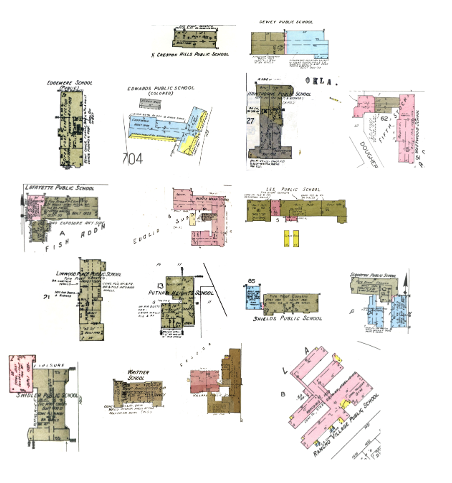
Abandoned historic schools in the USA have become a growing concern for urban communities, presenting a multifaceted issue that impacts social, environmental, and economic aspects of public life. Several factors contribute to the abandonment of historical public educational facilities, including demographic shifts, economic changes, and funding cuts. Since the postwar era, the economic and demographic decline of U.S. urban cores has left many interwar-period schools unmaintained and vacant. This neglect has led to informal occupation, declining neighborhood property values, increasing public maintenance costs, and, in many cases, demolitions. Focusing on Oklahoma City as a case study, this paper investigates the adaptive reuse viability of pre-World War 2 public schools. By analyzing 18 schools in the city’s urban core, we explore their typological characteristics through historical research, cluster analysis, and precedent study. Given the current housing affordability crisis in the USA, this study explores the possibility of repurposing historic school buildings into affordable housing, discussing the main design challenges associated with such conversions. Specifically, the reuse of historic schools into multifamily housing offers an opportunity to tackle housing affordability challenges while enhancing community values and meeting preservation goals.
The paper concludes with a set of design guidelines outlining key considerations for converting schools into residential use. The findings and recommendations can be generalized to similar contexts across the USA and other global cities facing concurrent issues of urban decay and housing shortage.
Accordino, John, and Gary T. Johnson. 2000. “Addressing the Vacant and Abandoned Property Problem.” Journal of Urban Affairs 22 (3): 301–15. https://doi.org/10.1111/0735-2166.00058.
Augenblick, John, and Kent C. McGuire. 1983. “Changes in the Equity of School Finance Systems in Oklahoma, Delaware, and Alaska on JSTOR.” Journal of Education Finance 8 (4): 436–48.
Badger, Emily, and Eve Washington. 2022. “The Housing Shortage Isn’t Just a Coastal Crisis Anymore.” The New York Times, July 14.
Baker, Lindsay. 2012. A History of School Design and Its Indoor Environmental Standards, 1900 to Today. National Clearinghouse for Educational Facilities. Washington, DC.
Barber, Brendan P. 2018. “Public School Closures: The Fate of Abandoned School Buildings.” Notre Dame Journal of Law, Ethics & Public Policy 32: 329.
Bowman, Ann, and Michael Pagano. 2004. Terra Incognita: Vacant Land and Urban Strategies. Georgetown University Press.
City of Oklahoma City, Planning Commission. 2020. “PlanOKC. Planning for a Healthy Future.” City of Oklahoma City, Planning Commission. https://planokc.org/wp-content/uploads/2020/04/01_planokc_final_20201210.pdf.
Davis, John Michael, Mariana Reyes, Jacob Abrogar, et al. 2023. “Puerto Rico’s Rescued Schools: A Grassroots Adaptive Reuse Movement for Abandoned School Buildings.” Social Sciences 12 (662). https://www.mdpi.com/2076-0760/12/12/662.
Economic and Planning Systems, Inc. 2021. Housing Affordability Study. Prepared for: City of Oklahoma City Planning Department. Denver, CO. https://www.okc.gov/files/assets/city/v/1/planning/plans-amp-studies/housing-affordability-study-2021.pdf.
Environmental Protection Agency. 1979. Asbestos Containing Materials in School Buildings. A Guidance Document. Part 1. Washington, DC.
Erickson, Ansley. 2018. “Schools in U.S. Cities.” In Oxford Research Encyclopedia of American History. October. https://doi.org/10.1093/acrefore/9780199329175.013.128
Garvin, Alexander. 2013. The American City: What Works, What Doesn’t: 3rd edition. McGraw Hill.
Garvin, Eugenia, Charles Branas, Shimrit Keddem, Jeffrey Sellman, and Carolyn Cannuscio. 2013. “More than Just an Eyesore: Local Insights and Solutions on Vacant Land and Urban Health.” Journal of Urban Health: Bulletin of the New York Academy of Medicine 90 (3): 412–26. https://doi.org/10.1007/s11524-012-9782-7.
Gulliford, Andrew. 1996. America’s Country Schools. University Press of Colorado.
Hamlin, A.D.F. 1910. Modern School Houses: Being a Series of Authoritative Articles on Planning, Sanitation, Heating and Ventilation. Vol. 1. The Swetland Publishing Co.
Hille, T. 2011. Modern Schools: A Century of Design for Education. 1st edition. Wiley.
Hoyt, Hannah. 2020. More for Less? An Inquiry into Design and Construction Strategies for Addressing Multifamily Housing Costs. Joint Center for Housing Studies of Harvard University. https://www.jchs.harvard.edu/sites/default/files/harvard_jchs_gramlich_design_and_construction_strategies_multifamily_hoyt_2020_3.pdf.
Jackson, Kenneth T. 1987. Crabgrass Frontier: The Suburbanization of the United States. First Edition. Oxford University Press.
Jo Meacham Associates. 2001. Architectural Historical Survey of Oklahoma City’s Historic School Buildings. Oklahoma City, OK.
Joint Center for Housing Studies of Harvard University. 2023. The State of the Nation’s Housing 2023. Joint Center for Housing Studies of Harvard University. https://www.jchs.harvard.edu/sites/default/files/reports/files/Harvard_JCHS_The_State_of_the_Nations_Housing_2023_0.pdf
Jonge, Wessel de. 2017. “Sustainable Renewal of the Everyday Modern.” Journal of Architectural Conservation 23 (1–2): 62–105. https://doi.org/10.1080/13556207.2017.1326555
Kuipers, Marieke, and Wessel de Jonge. 2017. Designing from Heritage: Strategies for Conservation and Conversion. BK BOOKS. https://doi.org/10.7480/isbn.9789461868022.
Li, Yuan, Long Zhao, Jingxiong Huang, and Andrew Law. 2021. “Research Frameworks, Methodologies, and Assessment Methods Concerning the Adaptive Reuse of Architectural Heritage: A Review.” Built Heritage 5 (1): 6. https://doi.org/10.1186/s43238-021-00025-x.
Madden, David, and Peter Marcuse. 2016. In Defense of Housing: The Politics of Crisis. Verso.
Martínez-Rocamora, Alejandro, Pilar Díaz-Cuevas, Juan Camarillo-Naranjo, David Gálvez-Ruiz, and Patricia González-Vallejo. 2024. “Identification of Residential Building Typologies by Applying Clustering Techniques to Cadastral Data.” Journal of Building Engineering 86 (June): 108912. https://doi.org/10.1016/j.jobe.2024.108912.
McCue, Daniel, and Sophie Huang. 2024. “Estimating the National Housing Shortfall.” Joint Center for Housing Studies of Harvard University, January 29. https://www.jchs.harvard.edu/blog/estimating-national-housing-shortfall.
Metropolitan Library System. 2020. “List of Buildings throughout Oklahoma City Public Schools’ History.” https://www.metrolibrary.org/archives/essay/2019/07/list-buildings-throughout-oklahoma-city-public-schools-history.
Mills, Wilbur T. 1910. American School Building Standards. Franklin Educational Publishing Company.
Montgomery, Catherine, and Kelli Gaston. 2017. Dunbar School. National Register of Historic Places Registration Form. Oklahoma City, OK. http://nr2_shpo.okstate.edu/pdfs/SG100002217.pdf.
Moore, Deborah P., Ed. 1991. Guide for Planning Educational Facilities: An Authoritative and Comprehensive Guide to the Planning of Educational Facilities from the Conception of Need Through the Utilization of the Facility. Council of Educational Facility Planners, International.
Mosey, Grant, and Brian Deal. 2021. “Optimizing Multi-Family Building Massing for Affordability and Envelope Performance: An Investigation of the Trade-Offs Implicit in Low Rise Residential Buildings.” Buildings 11 (3): 3. https://doi.org/10.3390/buildings11030099.
National Center for Education Statistics. 2023. “Closed Schools.” https://nces.ed.gov/fastfacts/display.asp?id=619.
Newman, Galen, Donghwan Gu, Jun-Hyun Kim, Ann O’’. M. Bowman, and Wei Li. 2016. “Elasticity and Urban Vacancy: A Longitudinal Comparison of U.S. Cities.” Cities 58 (October): 143–51. https://doi.org/10.1016/j.cities.2016.05.018.
Ohmura, Takahiro, Yuji Katagiri, and Tatsuo Iwaoka. 2019. “Typological Structure in Contemporary Architecture Made of a Square Plan—A Study on the Geometry and Scale in Architecture.” Japan Architectural Review. https://doi.org/10.1002/2475-8876.12121.
OKCPS. 2019. Oklahoma City Public Schools Pathway to Greatness https://www.okcps.org/domain/1312.
O’Meara, Mark. 2015. “Historic Schools Go Hand-In-Hand with Housing.” Novogradac Journal of Tax Credits VI (XII).
Pfister, Tom. 2018. “Why An Oklahoma City Real Estate Development Scored A Prestigious Preservation Award.” Forbes, November 17.
PolicyMap. 2025. “Estimated Percent of All Renters Who Are Cost Burdened, between 2019-2023.” https://www.policymap.com/newmaps/e/www.
Robertson, Claudette. 2006. Douglass High School. National Register of Historic Places Registration Form. http://nr2_shpo.okstate.edu/pdfs/7000259.pdf.
Schwartz, Alex F. 2021. Housing Policy in the United States. 4th ed. Routledge.
Shahi, Sheida, Mansour Esnaashary Esfahani, Chris Bachmann, and Carl Haas. 2020. “A Definition Framework for Building Adaptation Projects.” Sustainable Cities and Society 63 (December): 102345. https://doi.org/10.1016/j.scs.2020.102345.
Sheals, Debbie, and Mason Martel. 2018. Harmony School. National Register of Historic Places Registration Form. http://nr2_shpo.okstate.edu/pdfs/SG100004742.pdf.
Spinaris, George J. 2012. Feasibility of Decommissioned Urban Schools: Emphasis Private Involvement. Purdue University, College of Technology. https://docs.lib.purdue.edu/cgi/viewcontent.cgi?article=1082&context=techmasters.
Steffen, Mike, and Walsh Construction Co. 2019. Exploring a Path Towards Cost-Efficient, Energy-Efficient Affordable Housing. 23rd Annual Westford Symposium on Building Science, August 5-7, 2019.
Stouffs, Rudi, and Bige Tunçer. 2015. “Typological Descriptions as Generative Guides for Historical Architecture.” Nexus Network Journal 17 (3): 785–805. https://doi.org/10.1007/s00004-015-0260-x.
Tanner, C. Kenneth, and Jeff Lackney. 2005. Educational Facilities Planning: Leadership, Architecture, and Management. Pearson.
Tsenkova, Sasha. 2023. “Perspective Chapter: Reimaging Affordable Housing through Adaptive Reuse of Built Heritage | IntechOpen.” In Future Housing, Edited by Alessandra Battisti. Intechopen.
U.S. Bureau of the Census. 2021a. “ACS 5-Year 2021 DP05 Demographics and Housing Estimates.” American Community Survey. https://data.census.gov/table/ACSDP5YSPT2021.DP05?q=population%20oklahoma%20&g=040XX00US40$3100000_310XX00US36420&y=2021.
U.S. Bureau of the Census. 2021b. “ACS 5-Year 2021 S2504 Physical Housing Characteristics for Occupied Housing Units.” American Community Survey. https://data.census.gov/table/ACSST5Y2021.S2504?q=housing%20characteristics&g=040XX00US40&y=2021.
US Department of Housing and Urban Development Location Affordability Portal. 2019. “HUD Location Affordability Index.” https://www.hudexchange.info/programs/location-affordability-index/.
Vafaie, Fatemeh, Hilde Remøy, and Vincent Gruis. 2023. “Adaptive Reuse of Heritage Buildings; a Systematic Literature Review of Success Factors.” Habitat International 142 (December): 102926. https://doi.org/10.1016/j.habitatint.2023.102926.
Willert, Tim. 2019. “OKC District Could Close as Many as 20 Schools.” The Oklahoman (Oklahoma City, OK), January 18.
Copyright (c) 2026 Hiroki Mishima, Francesco Cianfarani

This work is licensed under a Creative Commons Attribution-NonCommercial-ShareAlike 4.0 International License.
Authors who publish with this journal agree to the following terms:
- Authors retain copyright and grant the journal right of first publication with the work simultaneously licensed under a Creative Commons Attribution License that allows others to share the work with an acknowledgement of the work's authorship and initial publication in this journal which is under a Attribution-NonCommercial-ShareAlike 4.0 International license (CC BY-NC-SA 4.0).
- Authors are able to enter into separate, additional contractual arrangements for the non-exclusive distribution of the journal's published version of the work (e.g., post it to an institutional repository or publish it in a book), with an acknowledgement of its initial publication in this journal.
- Authors are permitted and encouraged to post their work online (e.g., in institutional repositories or on their website) prior to and during the submission process, as it can lead to productive exchanges, as well as earlier and greater citation of published work (See The Effect of Open Access).