Developing a Structured Framework for Enhanced Experience in KashiVishwanath Dhaam: A Confirmatory Factor Analysis

Downloads
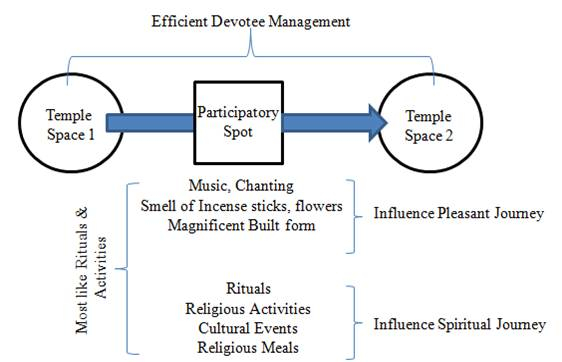
Temple experiences are complex and multifaceted, encompassing spiritual, emotional, and social dimensions. Observing, understanding and analyzing these experiences can render important insights to authorities to make devotee journey memorable. There is abundant research done to explore the issues and experiences of devotees separately so there is already a strong background of parameters that influence the journey but no research is done holistically to study pleasant, spiritual encounters and devotee management in different temple spaces. Indeed, all these factors have magnificent capacity to influence cognitive behavior of its users. In a temple these constructs have a twofold role i) is being responsible for visit intentions, rituals, likeliness, temple shrine and precinct experience leading to ii) formation of memories. So, the researchers set out to identify the most dominant indicators of these constructs which would be organized during temple journey to intensify devotee interaction. To validate the efficacy of so formed model, in the temple complex of KashiVishwanath Dhaam, on a sample consisting of 200 devotees (both local & pilgrim) Confirmatory Factor Analysis (CFA) was employed. CFA is a technique that yields result for i) fitness of model with respect to data and ii) factor loadings, variance and covariance of the observed parameters. The aim of the study is to evaluate the psychometric properties of the individual indicators, through structured questionnaire, that contribute to the complete journey experience categorized under pleasant, spiritual and devotee management constructs. The findings revealed that the questionnaire has substantial validity for evaluation of pleasant journey (PJ) with three-factor model of 12 indicators, spiritual journey (SJ) with four-factor model of 18 indicators and devotee management (DM) with three factor model of 15 indicators. The indicators used for the study are distinct yet interconnected reflecting the complex nature of temple experiences. The study significantly represents a progression in the existing literature that highlights the significant aspects for enhanced temple experiences.
Afzhool, Nadereh, and Ayten Özsavas Akçay. "Influence of the Hinduism Religion on Architectural Identity of Hindu Temple." Proceedings of the International Conference of Contemporary Affairs in Architecture and Urbanism-ICCAUA, 5(1). https://doi.org/10.38027/ICCAUA2022EN0231, 2022. 270–278.
Agbonome, Peter, Nzewi, Nnamaka, Ifebi, Oluchi. "Activity As Key Factor in Space Design in Architecture." Tropical Built Environment Journal (TBEJ),2, 2016.
Alkhadim, M., Gidado, K., and Painting, N. "Perceived Crowd Safety in Large Space Buildings: The Confirmatory Factor Analysis of Perceived Risk Variables." Journal of Engineering Project and Production Management,8(1), 2018: 22-39.
Almeida, Maria Moitinho de, and Johan von Schreeb. "Human Stampedes: An Updated Review of Current Literature." Prehospital and Disaster Medicine 34, no. 1, 2019: 82–88, https://doi.org/10.1017/S1049023X18001073.
André, Mark St. "A Confirmatory Factor Analysis of the Latent Structure and Measurement Invariance in the University of Utah’s Student Course Feedback Instrument." CFA of Latent Structure in Utah’s SCF. University of Utah, April 22, 2012.
Aron, Sunita. "Keeping up with UP | Religious tourism, temple economics and the state’s economy." Hindustan Times. October 10, 2024. https://www.hindustantimes.com/opinion/keeping-up-with-up-religious-tourism-temple-economics-and-the-state-s-economy-101728566347387.html (accessed July 15, 2025).
Asthana, Pradeep Kumar. "A Study Of Relationship Between Religious Tourism And Individual's Satisfaction." Revista de Turism: Studii si Cercetari in Turism, 2019.
Aziz, Barbara Nimri. "Personal Dimensions of the Sacred Journey: What Pilgrims Say." Religious Studies 23, no. 2, 2015: 247–61,http://www.jstor.org/stable/20019212.
Baek, Kyuri, Yunseon Choe, Seungjae Lee, Gyehee Lee, and Tae-Il Pae. "The Effects of Pilgrimage on the Meaning in Life and Life Satisfaction as Moderated by the Tourist’s Faith Maturity." Sustainability 14, no. 5: 2891, 2022: https://doi.org/10.3390/su14052891.
Bandyopadhyay, A. "Understanding the Architecture of Hindu Temples: A Philosophical Interpretation." World Academy of Science, Engineering and Technology, Open Science Index 156, International Journal of Architectural and Environmental Engineering, 13(12), 2019: 718 - 722.
Bathla, Amit, Rawat, Sandeep. "Haridwar stampede: 8 dead, 30 injured in stampede at Mansa Devi temple." Hindustan Times. July 28, 2025. https://www.hindustantimes.com/india-news/haridwar-stampede-8-dead-30-injured-in-stampede-at-mansa-devi-temple-101753662237132.html (accessed August 2025).
Bhatt, Mihir R. "Crowd Management in India." Crowd Management in India, Issue No 158, July 2017: 12.
Cheung, G.W., Cooper-Thomas, H.D., Lau, R.S. et al. "Reporting reliability, convergent and discriminant validity with structural equation modeling: A review and best-practice recommendations." Asia Pac J Manag 41, 2024: 745–783,https://doi.org/10.1007/s10490-023-09871-y.
Chokshi, Manasi. "The Study of Inter-Relationship between Spaces and Stories: Case of Meenakshi Temple, Madurai." International Journal of Engineering Research,7(1), 2018: 101-104.
Darfoon, Mohamed. "An Examination of Service Quality and Satisfaction in a Religious Tourism Setting." All Dissertations. Clemson University,https://open.clemson.edu/all_dissertations/1166, 2013.
DiStefano, C., & Hess, B. "Using confirmatory factor analysis for construct validation: An empirical review." Journal of Psychoeducational Assessment,23(3), 2005: 25-241.https://doi.org/10.1177/073428290502300303.
Dwivedi, A.V. "Architecture (Hinduism)." In Hinduism and Tribal Religions. Encyclopedia of Indian Religions, https://doi.org/10.1007/978-94-024-1036-5_450-1. Dordrecht: Springer, 2019.
Edison, J.C, Singla, Harish. "Development of a scale for factors causing delays in infrastructure projects in India." Construction Economics and Building,20, 2020,: 10.5130/AJCEB.v20i1.6750.
Ewa Dębicka-Borek, Lidia Sudyka. "From the Narratives on Mythical Beasts to the Voicing of Power: The Case of the Vīrabhadra Temple in Keladi." Cracow Indological Studies, 2022.
Gagne, Phill, and Gregory R. Hancock. "Measurement Model Quality, Sample Size, and Solution Propriety in Confirmatory Factor Models." Multivariate Behavioral Research 41 (1), 2006: 65–83. doi:10.1207/s15327906mbr4101_5.
Gokhale, Vasudha. "Temple As “Place In Ageing” For Elderly People In Indian Urban Settings." Journal Of The Indian Institute Of Architects, 2014.
Grace-Martin, Karen. How big a Sample Size do you need for Factor Analysis? September 23, 2021. https://www.theanalysisfactor.com/sample-size-needed-for-factor-analysis/ (accessed 2024).
Granoff, Phyllis. "Defining Sacred Place: Contest, Compromise, AND Priestly Control in some Mahatmaya texts." Annals of the Bhandarkar Oriental Research Institute, Vol. 79, No. 1/4, 1998: 1-27.
Gupta, Shruti. "Phenomenon of Experiential Space." Morphogenesis - Built Environment Research. May 10, 2016. https://www.morphogenesis.org/media/phenomenon-of-experiential-space/ (accessed December 9, 2024).
Gupta, Tanvi. "Impact of Architecture on Human Behaviour." Rethinking the Future. January 15, 2024. https://www.re-thinkingthefuture.com/2022/08/17/a7565-impact-of-architecture-on-human-behaviour/.
Haba, Herman Fassou and Dastane, Omkar. "An Empirical Investigation on Taxi Hailing Mobile App Adoption: A Structural Equation Modelling." Business Management and Strategy,9(2), 2018: https://ssrn.com/abstract=3166789.
Huq, Sheikh,Aktar, Mst. "Influential Factors of Visitors’ Satisfaction: Evidence from JUJBR, Kantanagar Temple, Dinajpur." JUJBR Influential Factors of Visitors' Satisfaction: Evidence from Kantanagar Temple, Dinajpur, 2021.
Ikibe J. H., Akande, O.K. "Crowd Control in Public Building Designs: Current Trend and Strategies for Ecclesiastical Buildings in Abuja, Nigeria." Journal of Architecture and Construction,1(3), 2018: 25-33.
Illiyas, Faisel T, Mani, Shibu K, Pradeepkumar, A.P, Mohan, Keshav. "Human stampedes during religious festivals: A comparative review of mass gathering emergencies in India." International Journal of Disaster Risk Reduction,5, 2013: 10-18.
Illiyas, Faisel T., Shibu K. Mani, and Naveen and Babu. "Carrying Capacity Assessment for Religious Crowd Management - An Application to Sabarimala Mass Gathering Pilgrimage, India." International Journal of Religious Tourism and Pilgrimage, Vol. 8: Iss. 8, Article 8., 2020: doi:https://doi.org/10.21427/82rw-fx96.
Jesurajan, S.Vargheese Antony, and S. Varghees Prabhu. "Dimensions Of Spiritual Tourism In Tuiticorin District of Tamil Nadu In India-A Critical Analysis." Business Intelligence Journal,5, Issue 2, 2012.
Joseph, J.K., Ambady, K.G., Dev, K.A. et al. "Pilgrim satisfaction in a mass religious gathering: Study from Sabrimala Destination,Kerla State of India." J Relig Health 59, 2020: 1713–1727,https://doi.org/10.1007/s10943-019-00814-w.
nawaJugessur, Yudhistir S.M.F. "Reliability and Internal Consistency of data: Significance of Calculating Cronbach’s Alpha Coefficient in Educational Research." International Journal of Humanities and Social Science Invention,11(04), 2022: 9-14,10.35629/7722-1104030914.
Jyotsna, J. H., and L. Prakash Sai. "Modelling pilgrim-tourist experience in Hindu religious destinations: an Interactive Qualitative Analysis." Journal of Tourism and Cultural Change 21 (3), 2022: 364–82, doi:10.1080/14766825.2022.2095914.
Karwaan, Team. "Spatial Organization and Circulation Patterns in Conceptual Design." Architecture. Karwaan, September 20, 2024.
Kimaru, Jennifer Wanjiku. "Mass Assemblies And Vulnerability To Disasters: The Case Of Selected Churches In Nairobi." Project Paper Submitted in Partial Fulfillment for the Award of Masters of Arts Degree In Sociology (Disaster Management). University Of Nairobi, October 10, 2015.
Kingshott, Brian F. "Crowd Management: Understanding Attitude & Behavior." Journal of Applied Security Research 9(3),, 2014: 273-89,doi:10.1080/19361610.2014.913229.
Koski, Anssi, Anne Kouvonen, and Hilla Sumanen. "Preparedness for Mass Gatherings: Factors to Consider According to the Rescue Authorities." International Journal of Environmental Research and Public Health 17, no. 4: 1361,, 2020: https://doi.org/10.3390/ijerph17041361.
Kulshreshtha, S. "Introduction to Temples and Ritual." In The Routledge Handbook of HinduTemples, by H.P. Kulshreshtha, S., & Suvrathan, U. (Eds.). Ray, 516. Routledge India. https://doi.org/10.4324/9781003097709, 2022.
Kumar, Dr Punit. "Scientific Evolution of Acoustics and Optics in Indian Temples." Science India, 2024.
Kyriazos, T. "Applied Psychometrics: Sample Size and Sample Power Considerations in Factor Analysis (EFA, CFA) and SEM in General." Psychology 9, 2018: 207-2230,10.4236/psych.2018.98126.
Lakr, Harshit. "Disaster Preparedness for Mass Religious Gatherings in India- Learning from Case Studies." ResearchGate, 2015.
Lee Ris S., Hughes Roger L. "Exploring Trampling and Crushing in a Crowd." Journal of Transportation Engineering,131(8), 2005: 575-582,https://doi.org/10.1061/(ASCE)0733-947X(2005)131:8(575).
Lušňáková Zuzana, Lenčéšová Silvia, Šajbidorová Mária. "Growing role of CSR activities in the area of human resources management and its evaluation using quantitative methods." Mathematics in Education, Research and Applications,5, 2019: 16-29,10.15414/meraa.2019.05.01.16-29.
M.Rajakumari, R.Kalaiselvi, K.G.Preethi, S.R.Tharun Balaji. "Urban Design and Spatial Layout of Temple and Temple Towns of Tamilnadu-India." International Journal of Innovative Studies in Sciences and Engineering Technology,5, Issue 4, 2019: 4-8.
Mersal, Amira. "The Impact of Built Environment on Human Behavior." Environmental Science and Sustainable Development,2, 2018: 12.
Mitchell, George. The Hindu Temple: An Introduction to Its Meaning and Form. Chicago & London: University of Chicago Press, 1988.
Nain, Varnika & Iyer, Deeksha. Agama Shāstra: Exploring the art of Temple Design and Architecture through the Ages. Dakshi Publication,10.13140/RG.2.2.18766.57925, 2025.
Nath, Ajay. "10 injured in stampede-like situation at Jagannath temple in Puri." India Today. November 11, 2023. https://www.indiatoday.in/india/story/people-injured-stampede-like-situation-jagannath-temple-puri-odisha-mangala-aarti-2461565-2023-11-11 (accessed September 2024).
Nayak, Prof. Jogendra Kumar. "Confirmatory Factor Analysis in SPSS-III." Marketing Research and Analysis - II. July 2018. http://acl.digimat.in/nptel/courses/video/110107113/lec56.pdf (accessed May 5, 2024).
NDMA, GOV OF INDIA. Managing crowd at events and venues of mass gatherings. National Disaster Management Authority (NDMA), 2014.
Nguyen Viet, Bang, and Nguyen Van, Si. "Factors Affecting Satisfaction and Revisit-intention of Pilgrimage Tourists: Bà Chúa Xứ Shrine in Vietnam." International Journal of Religious Tourism and Pilgrimage: Vol. 9: Iss. 4, Article 9, 2021.
Ozturk, M. A. "Confirmatory Factor Analysis of the Educators’ Attitudes Toward Educational Research Scale." Kuram ve Uygulamada Eğitim Bilimleri, 11(2), 2011: 737-747.
Patnayak, Ravindra. "Morphology and Character of Indian Temple Form." Universal Review, 2019: 16.
Patwardhan, V., Ribeiro, M. A., Payini, V., Woosnam, K. M., Mallya, J., & Gopalakrishnan, P. "Visitors’ Place Attachment and Destination Loyalty: Examining the Roles of Emotional Solidarity and Perceived Safety." Journal of Travel Research 59(1), 2019: 3-21.
Prasun, Ankita. "Stampede Management For Religious Events In India." Proceedings of 2015 International Conference on Disaster Management in Civil Engineering (ICDMCE’2015), 2015: 81-86.
Prasunamba, Dr. B. V. Muralidhar. "Crowd and queue management." Emperor International Journal of Finance and Management Research, 2017: 5.
Preston, Charles. "Hindu Temple Architecture." Britannica. May 5, 2025. https://www.britannica.com/topic/Hindu-temple (accessed September 25, 2025).
Quinlan, Kanchan. "Ritual Architecture:5 weeks,7 states,11 cities,1 village." Canada, Ottawa: Carleton University, May 18, 2013.
Raddock, Elisabeth Eva. "Listen how the wise one begins construction of a house for Viṣṇu:vijānatā yathārabhyaṃ gṛhaṃ vaiṣṇavaṃ śṛṇv evaṃ.Chapters 1-14 of the Hayaśīrṣa Pañcarātra." Doctoral Thesis-University of California, Berkeley. University of California, January 1, 2011.
Raineri, Aldo. "Contemporary Planning Approaches for Crowd Safety at Mass Gatherings." ResearchGate, 2016.
Rawat, Megha. "Stampede-like Situation Occurs At Banke Bihari Temple In UP's Mathura; 4 Devotees injured." Republicworld.com. November 7, 2022. https://www.republicworld.com/india-news/accidents-and-disasters/stampede-like-situation-occurs-at-banke-bihari-temple-in-ups-mathura-4-devotees-injured-articleshow.html (accessed September 2024).
Ray, Himanshu Prabha, Kulshreshtha, Salila, Suvrathan, Uthara. The Routledge Book of Hindu Temples. Taylor & Francis group,10.4324/9781003097709, 2023.
Rizvi, M.A.K., Hossain, M.Z. "Relationship Between Religious Belief and Happiness: A Systematic Literature Review." J Relig Health 56, 2017: 1561–1582,https://doi.org/10.1007/s10943-016-0332-6.
Rodríguez-Santero, Javier, Juan Jesús Torres-Gordillo, and Javier Gil-Flores. "Confirmatory Factor Analysis of a Questionnaire for Evaluating Online Training in the Workplace." Sustainability 12, no. 11: 4629., 2020: https://doi.org/10.3390/su12114629.
Rohman, Isnanda. "What Creates Tourist Satisfaction in Prambanan Temple?" KINERJA,25, 2021: 151-163.
Rybina, Liza, and Timothy J. Lee. "Traveler Motivation and Destination Loyalty: Visiting Sacred Places in Central Asia." Tourism & hospitality,2, no. 1, 2021: 1-14,https://doi.org/10.3390/tourhosp2010001.
Sadeghi Habibabad, Ali, Del, Mohammad, Mahdinejad, Jamal-E-Din. "Recognition of Durability of Sacred Images‘ Nature in the Iran Islamic Traditional Architecture Based on Identification of the Stable Identity of Iranian Congregational Mosques." Journal of Sustainable Architecture and Urban Design,4, 2017: 17-30.
Sahgal, Neha, Evans, Jonathan, Monique Salazar, o Starr, Ariana, Kelsey J, and Corichi, Manolo. RELIGION IN INDIA: TOLERANCE AND SEGREGATION. PEW research center, 2021.
Service, Express News. "Two die of suffocation in Janmashtami stampede at Banke Bihari temple." The NewIndian Express. August 20, 2022. https://www.newindianexpress.com/nation/2022/aug/20/two-die-of-suffocation-in-janmashtami-stampede-at-banke-bihari-temple-2489556.html (accessed September 2024).
Sharma, Hemender. "Several injured in stampede at Ujjain's Mahakaleshwar temple amid VIP visit." India Today. July 27, 2021. https://www.indiatoday.in/india/story/ujjain-mahakaleshwar-temple-stampede-injured-shivraj-singh-chouhan-1833024-2021-07-27 (accessed Frebruary 2022).
Sharma, Vikash. "Stampede-Like Situation At Puri Jagannath Temple As Devotees Break Barricade To Gain Entry." OdhishaTv.in. March 18, 2022. https://odishatv.in/news/miscellaneous/stampede-like-situation-at-puri-jagannath-temple-as-devotees-break-barricade-to-gain-entry-172987.
Shaw, Jodi. "Unfinished-ness: Ritual, Temple Structures, and the Sacred as Visceral Conversations." JUGAAD: A Material Religions Project, 2018: https://www.academia.edu/38262461/Unfinished_ness_Ritual_Temple_Structures_and_the_Sacred_as_Visceral_Conversations.
Singh Purnima, Tewari Shruti, Kesberg Rebekka, Karl Johannes Alfons, Bulbulia Joseph, and Fischer Ronald. "Time investments in rituals are associated with social bonding, affect and subjective health: a longitudinal study of Diwali in two Indian communities." Phil. Trans. R. Soc. B375, 2020: https://doi.org/10.1098/rstb.2019.0430.
Singh, Utkarsh, Jean-François Determe, François Horlin, and Philippe De Doncker. "Crowd Monitoring: State-of-the-Art and Future." IETE Technical Review 38 (6),, 2020: 578-94,578–94. doi:10.1080/02564602.2020.1803152.
Soltani, Saeid, Kırcı, Nazan. "Phenomenology and Space in Architecture: Experience, Sensation and Meaning." International Journal of Architectural Engineering Technology,6, 2019: 10.15377/2409-9821.2019.06.1.
Sorokowska, A., Sorokowski, P., Hilpert, P., Cantarero, K., Frackowiak, T., Ahmadi, K., Alghraibeh, A. M., Aryeetey, R., Bertoni, A., Bettache, K., Blumen, S., Błażejewska, M., Bortolini, T., Butovskaya, M., Castro, F. N., Cetinkaya, H., Cunha, D., David. "Preferred Interpersonal Distances: A Global Comparison." Journal of Cross-Cultural Psychology,48(4), 2017: 577-592.https://doi.org/10.1177/0022022117698039.
Sridhar, Dr Ravindranath, Muppala, Murthy, Dr. "Pilgrim Satisfaction of Religious Event." Interscience Management Review, 2008: 1-10.
Steyer, R. "Classical (Psychometric) Test Theory." In International Encyclopedia of the Social and Behavioral Sciences, by Paul B. Baltes Neil J. Smelser. Elsevier, 2001.
Tavakol, Mohsen and Angela P. "Factor Analysis: a means for theory and instrument development in support of construct validity." International Journal of Medical Education 11, 2020: 245 - 247.
TNN. "Times Of India." 6.5L & Counting: K V Dhaam is ultimate NY hotspot again. January 2, 2024. https://timesofindia.indiatimes.com/city/varanasi/kashi-vishwanath-temple-in-varanasi-ultimate-new-year-hotspot-with-65-lakh-devotees/articleshow/106464776.cms (accessed 2024 16, December).
Vembu, N.R., Sivakumar, M, Srinivasan, S., Veeramani, G, Senthilvel, S, Vanitha, R. "Spiritual Tourism and Identification of Satisfaction Among Pilgrims – An Empirical Study." International Journal of Economic Research,14, 2017: 497-510.
Verma, Ashish, Verma, Meghna, Sarangi, Punyabeet, Yadav, Vivek, M, Manoj. "Activity participation, episode duration and stop-making behavior of pilgrims in a religious event: An exploratory analysis." Journal of Choice Modelling,38, 2021.
Wang, Jinghong, Jin, Bowei, Li, Jia, Chen, Fanghao, Wang, Zhirong, Sun, Jinhua. "Method for guiding crowd evacuation at exit: The buffer zone." Safety Sciences,118, 2019: 88-9,https://doi.org/10.1016/j.ssci.2019.05.014.
Yadav, Pooja. "Explained: Why Varanasi Was Named The First Cultural And Tourism Capital Of The SCO." News. India Times, August 8, 2025.
Zeitz, Kathryn M., Heather M. Tan, M Grief, PC Couns, and Christopher J. Zeitz. "Crowd Behavior at Mass Gatherings: A Literature Review." Prehospital and Disaster Medicine 24, no. 1, 2009: 32-38,https://doi.org/10.1017/S1049023X00006518.
Copyright (c) 2026 Urvashi Tiwari Dixit, Dr Suruchi Modi, Dr. Ramanjyot Shrivastava

This work is licensed under a Creative Commons Attribution-NonCommercial-ShareAlike 4.0 International License.
Authors who publish with this journal agree to the following terms:
- Authors retain copyright and grant the journal right of first publication with the work simultaneously licensed under a Creative Commons Attribution License that allows others to share the work with an acknowledgement of the work's authorship and initial publication in this journal which is under a Attribution-NonCommercial-ShareAlike 4.0 International license (CC BY-NC-SA 4.0).
- Authors are able to enter into separate, additional contractual arrangements for the non-exclusive distribution of the journal's published version of the work (e.g., post it to an institutional repository or publish it in a book), with an acknowledgement of its initial publication in this journal.
- Authors are permitted and encouraged to post their work online (e.g., in institutional repositories or on their website) prior to and during the submission process, as it can lead to productive exchanges, as well as earlier and greater citation of published work (See The Effect of Open Access).