A Grounded Theory of Dignified Design Informed by Residents and Staff in Permanent Supportive Housing

Downloads
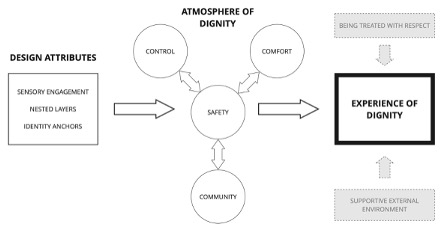
This study addresses a critical and timely issue—how the built environment can support dignity for individuals experiencing housing instability. Common definitions of dignity include autonomy, respect, self-determination, freedom, and equality. For people experiencing housing and health instability, everyday life is extremely stressful, and the built environment can play a critical role in supporting psychological and somatic regulation (Devlin 2018). Ajeen and colleagues (2023) found that many participants perceived that trauma-informed design updates for homeless shelter bedrooms increased their experiences of dignity and safety. For this study, a practice-embedded research team collected observations of use at various supportive housing sites, documented through photos and note-taking, and conducted semi-structured interviews and focus groups in two phases with a total of 115 resident and staff participants. The team inductively analyzed this large dataset of text and images using grounded theory methods. Analysis revealed that the experiences of comfort, community, and control are deeply interdependent and together create a rich and layered sense of safety for participants. Key design attributes—categorized as sensory engagement, nested layers, and identity anchors—emerged as critical for creating an atmosphere of dignity, which significantly contributed to the overall experience of dignity for participants. Ultimately, the research resulted in a grounded theory model of Dignified Design, establishing a framework for architects, designers, and other creators of service-oriented spaces.
Ajeen, Rawan, Dana Ajeen, Jennifer P. Wisdom, Jeffrey A. Greene, Tina Lepage, Charlotta Sjoelin, et al. 2023. “The Impact of Trauma-Informed Design on Psychological Well-Being in Homeless Shelters.” Psychological Services 20 (3): 680–89. https://doi.org/10.1037/ser0000724.
Al Khatib, Inas, Fatin Samara, and Malick Ndiaye. 2024. “A Systematic Review of the Impact of Therapeutical Biophilic Design on Health and Wellbeing of Patients and Care Providers in Healthcare Services Settings.” Frontiers in Built Environment 10. https://doi.org/10.3389/fbuil.2024.1467692.
Andrejević, Milan, Jakob Hohwy, and Linda Barclay. 2025. “Dignity Is Distinct From Respect: How Treating Others With Dignity Entails Accounting for Their Self-Conscious Emotions.” Personality & Social Psychology Bulletin. https://doi-org.du.idm.oclc.org/10.1177/01461672251319063.
Aranda, Kay, and Andrea Jones. 2010. “Dignity in Health-Care: A Critical Exploration Using Feminism and Theories of Recognition.” Nursing Inquiry 17 (3): 248-56. https://doi-org.du.idm.oclc.org/10.1111/j.1440-1800.2010.00494.x.
Arel, Stephanie N. 2024. “Shame, Trauma, and Guilt: Restoring Dignity Through Empathy.” In Probing Human Dignity, edited by Stephanie N. Arel, Vanessa Hellmann, and Levi Cooper. Springer Nature Switzerland. https://doi.org/10.1007/978-3-031-42437-3_12
Barclay, Linda. 2016. “In Sickness and In Dignity: A Philosophical Account of the Meaning of Dignity in Health Care.” International Journal of Nursing Studies 61: 136–41. https://doi.org/10.1016/j.ijnurstu.2016.06.010
Bittencourt, Moema B., and Maria I. Amaro. 2019. “Social Work, Human Rights and Conceptions of Human Dignity: The Case of Social Workers in Lisbon.” Portuguese Journal of Social Sciences 18 (3): 341–58. https://doi.org/10.1386/pjss_00014_1.
Bollo, Christina and Donofrio, Amanda. (2021). Trauma-informed design for permanent supportive housing: four case studies from Seattle and Denver. Housing and Society. https://10.1080/0f8882746.2021.1989570.
Borowski, Allan. 2022. “On Human Dignity and Social Work.” The British Journal of Social Work 52 (2): 609–623. https://doi.org/10.1093/bjsw/bcab016.
Bourke, Brian. 2014. “Positionality: Reflecting on the Research Process.” The Qualitative Report,19(33): 1-9. https://doi.org/10.46743/2160-3715/2014.1026
Browning, William D., and Catherine O. Ryan. 2020. Nature Inside: A Biophilic Design Guide. RIBA Publications.
Buchanan, Richard. 2001. “Human Dignity and Human Rights: Thoughts on the Principles of Human-Centered Design.” Design Issues 17 (3): 35–39. https://doi.org/10.1162/074793601750357178.
Caldeira, Sílvia, Margarida Vieira, Fiona Timmins, and Wilfred McSherry. 2017. “From the Struggle of Defining to the Understanding of Dignity: A Commentary on Barclay (2016) ‘In Sickness and in Dignity: A Philosophical Account of the Meaning of Dignity in Health Care.’” International Journal of Nursing Studies 67: 1–2. https://doi-org.du.idm.oclc.org/10.1016/j.ijnurstu.2016.11.011.
Charmaz, Kathy. 1996. “The Search for Meanings: Grounded Theory.” In Smith, Jonathan, Rom Harré, and Luk V. Langenhove, Eds. Rethinking Methods in Psychology. SAGE Publications. https://doi.org/10.4135/9781446221792.
Charmaz, Kathy. 2000. “Grounded theory: Objectivist and constructivist methods.” In D.K. Denzin & Y. S. Lincoln, Eds. Handbook of Qualitative Methods. SAGE Publications.
Corbin, Juliet, and Anselm Strauss. 2007. Basics of Qualitative Research (3rd Ed.): Techniques and Procedures for Developing Grounded Theory. SAGE Publications. https://doi.org/10.4135/9781452230153.
Creswell, John W. 2013. Qualitative Inquiry & Research Design: Choosing Among Five Approaches (3rd Ed). SAGE Publications. http://ci.nii.ac.jp/ncid/BB09168370.
Devlin, Ann S. 2018. Environmental Psychology and Human Well-Being: Effects of Built and Natural settings. Academic Press.
Douglas, Sheila, Leah Macaden, Kevin Muirhead, Elaine Webster, and Liz Ellis. “Dignity and Human Rights—Survey Findings on Undergraduate Nursing Students’ Conceptualisation and Operationalisation of Dignity.” Nursing Open 12 (4): e70194-n/a. https://doi-org.du.idm.oclc.org/10.1002/nop2.70194.
Faerden, Ann, Christine Rosenqvist, Mats Håkansson, Eline Strøm-Gundersen, Åshild Stav, Jan Svartsund, Trude Røssæg. 2023. “Environmental Transformations Enhancing Dignity in an Acute Psychiatric Ward: Outcome of a User-Driven Service Design Project.” HERD Health Environments Research & Design Journal 16 (2): 55–72. https://doi.org/10.1177/19375867221136558.
Fitzpatrick-Lewis, Donna, Rebecca Ganann, Shari Krishnaratne, Donna Ciliska, Fiona Kouyoumdjian, and Stephen W. Hwang. 2011. “Effectiveness of Interventions to Improve the Health and Housing Status of Homeless People: A Rapid Systematic Review.” BMC Public Health 11 (1): 638. https://doi.org/10.1186/1471-2458-11-638.
Fleming, Richard, John Zeisel, Kirsty Bennett, Jan Golembiewski, Kate Swaffer, and Lynda Henderson. 2023.“Towards a Dignity Manifesto of Design – For People Living With Dementia.” Architectural Science Review 66 (5): 358–59. https://doi.org/10.1080/00038628.2022.2136347.
Gallagher, Ann. 2004. “Dignity and Respect for Dignity – Two Key Health Professional Values: Implications for Nursing Practice.” Nursing Ethics 11 (6): 587–99. https://doi.org/10.1191/0969733004ne744oa.
Garcia, Cheyenne, Kelly Doran, and Margot Kushel. 2024. “Homelessness and Health: Factors, Evidence, Innovations That Work, and Policy Recommendations.” Health Affairs 43 (2): 164–71. https://doi.org/10.1377/hlthaff.2023.01049.
Glaser, Barney, and Anselm Strauss. 1967. The discovery of grounded theory: Strategies for qualitative research. Transaction Publishers.
Greene, Melanie. 2014. “On the Inside Looking In: Methodological Insights and Challenges in Conducting Qualitative Insider Research.” The Qualitative Report, 19(29): 1-13. https://doi.org/10.46743/2160-3715/2014.1106
Hodgkiss, Phillip. 2013. “A Moral Vision: Human Dignity in the Eyes of the Founders of Sociology.” The Sociological Review 61 (3): 417–39. https://doi.org/10.1111/1467-954x.12049.
Iuculano, John, and Keith Burkum. 1996. “The Humanism of Sartre: Toward a Psychology of Dignity.” Journal of Theoretical and Philosophical Psychology 16 (1): 19–29. https://doi.org/10.1037/h0091150.
Jacobson, Nora. 2007. “Dignity and Health: A Review.” Social Science & Medicine 64 (2): 292–302. https://doi.org/10.1016/j.socscimed.2006.08.039.
Justus, Joanne and Sumruti Raghani. 2024. “Trauma-Informed design: Shelter Homes for Runaway Children.” International Journal of Adolescence and Youth 30 (1). https://doi.org/10.1080/02673843.2024.2445053.
Kim, Miso. 2018. “Designing for Participation: Dignity and Autonomy of Service (Part 2)”. Design Issues 34 (3): 89–102. https://doi.org/10.1162/desi_a_00499.
Kuo, Frances and William Sullivan. 2001. “Environment and Crime in the Inner City.” Environment and Behavior 22 (3): 343-67. https://doi.org/10.1177/0013916501333002.
Lamberton, Cait and Sharon Shavitt. 2019. “Toward a Dignity Architecture: The Critical Challenges of Stigmatized‐Identity Cues for Consumer Psychology.” Journal of Consumer Psychology, 29 (1), 152–59.https://doi.org/10.1002/jcpy.1077.
Löwstedt, Anthony, and Altijana Kapidžić. 2023. “Communication in Dignity Since Early Antiquity: From Ptahhotep to Current Ethics and International Law.” Journal of Intercultural Communication Research 52 (6): 567–84. https://doi.org/10.1080/17475759.2023.2264851
Lucas, Kristen. 2015. “Workplace Dignity: Communicating Inherent, Earned, and Remediated Dignity.” Journal of Management Studies 52 (5): 621–46. https://doi.org/10.1111/joms.12133.
Maslow, Abraham. 1943. “A Theory of Motivation.” Psychological Review 50 (4): 370-96.
Mattson, David, and Susan Clark. 2011. “Human Dignity in Concept and Practice.” Policy Sciences 44 (4): 303–19. https://doi.org/10.1007/s11077-010-9124-0.
May, James, and Erin Daly. 2022. “Introduction to Dignity Law.” Journal of Disaster Research 17 (3): 301–07. https://doi.org/10.20965/jdr.2022.p0301.
McMahon, Cian. 2023. “Human Dignity in Organisations: The Cooperative ideal.” Cambridge Journal of Economics 47 (4): 763–92. https://doi.org/10.1093/cje/bead022.
Mollvik, Lia. 2021. “Inflorescent Dignity: A Reconstructive Interpretation of Martha Nussbaum’s Conception of Dignity and Its Implications for Education.” Ethics and Education 16 (3): 336–54. https://doi.org/10.1080/17449642.2021.1927319.
Motulsky, Sue L. 2021. "Is member checking the gold standard of quality in qualitative research?" Qualitative Psychology 8 (3): 389.
Moran, Rebecca and Michael Salter. 2022. “Therapeutic Politics and the Institutionalisation of Dignity: ‘Treated Like the Queen.’” The Sociological Review 70 (5): 969–85. https://doi.org/10.1177/00380261221091012.
O’Connor, Cliodhna, and Helene Joffe. 2020. "Intercoder reliability in qualitative research: Debates and practical guidelines." International Journal of Qualitative Methods 19: 1-13.
Ohls, Carolina. 2020. “Dignity‐Based Practices in Norwegian Activation Work.” International Journal of Social Welfare 29 (2): 168–78. https://doi.org/10.1111/ijsw.12388.
Owen, Ceridwen and James Crane. 2022. "Trauma-Informed Design of Supported Housing: A Scoping Review Through the Lens of Neuroscience." International Journal of Environmental Research and Public Health 19 (21): 14279. https://doi.org/10.3390/ijerph192114279.
Phipps, Monique, Lisa Dalton, Hazel Maxwell, and Michelle Cleary. 2019. “Women and Homelessness, a Complex Multidimensional Issue: Findings from a Scoping Review.” Journal of Social Distress and the Homeless 28 (1): 1–13. https://doi.org/10.1080/10530789.2018.1534427.
Pless, Nicola M., Thomas Maak, and Howard Harris. 2017. “Art, Ethics and the Promotion of Human Dignity.” Journal of Business Ethics 144 (2): 223–32. https://doi.org/10.1007/s10551-017-3467-9.
Pols, Jeannette. 2013. “Through the Looking Glass: Good Looks and Dignity in Care.” Medicine Health Care and Philosophy 16 (4): 953–66. https://doi.org/10.1007/s11019-013-9483-3.
Robbins, Brent D. 2015. “The Heart of Humanistic Psychology.” Journal of Humanistic Psychology 56 (3): 223–37. https://doi.org/10.1177/0022167815591408.
Saldaña, Johnny. 2013. The Coding Manual for Qualitative Researchers. 2nd ed. Thousand Oaks, CA: SAGE Publications. http://ci.nii.ac.jp/ncid/BB20067005.
Saldaña, Johnny. 2011. Fundamentals of Qualitative Research. New York: Oxford University Press.
Schmidt, Jante. 2022. “Everyday Ethics of Dignity Work: What Social Workers Do to Promote the Dignity of Service-Users in Times of Austerity Measures and Welfare Stigma.” Ethics and Social Welfare 16 (3): 306–21. https://doi.org/10.1080/17496535.2022.2038229.
Schmidt, Jante, Alister Niemeijer, Carlo Leget, Margo Trappenburg, and Evelien Tonkens. 2020. “The Dignity Circle: How to Promote Dignity in Social Work Practice and Policy?” European Journal of Social Work 23 (6): 945–57. https://doi.org/10.1080/13691457.2020.1804332.
Schroeder, Krista, Jennie G. Noll, Kevin A. Henry, Shakira F. Suglia, and David B. Sarwer. 2021. “Trauma-Informed Neighborhoods: Making the Built Environment Trauma-Informed.” Preventive Medicine Reports 23: 101501. https://doi.org/10.1016/j.pmedr.2021.101501.
Simola, Sheldene. 2024. “Dignity-Infused and Trauma-Informed, Contemplative Pedagogy for Preventing Moral Injury and Promoting Wellbeing.” Humanistic Management Journal 9 (3): 373–95. https://doi.org/10.1007/s41463-024-00179-7.
Small, Mario Luis, and Jessica McCrory Calarco. 2022. Qualitative literacy: A guide to evaluating ethnographic and interview research. Berkely: University of California Press.
Sternberg, Esther. 2018. "The Impact of the Built Environment on Health—The Brain's Stress Response and the Brain-Immune Connection: Implications for Health Care and Urban Design." In Green Community, pp. 144–151. Abingdon, UK: Routledge.
Strauss, Anselm, and Juliet Corbin. 1998. Basics of Qualitative Research: Techniques and Procedures for Developing Grounded Theory. Thousand Oaks, CA: SAGE Publications
Stevenson, Nick. 2014. “Human(e) Rights and the Cosmopolitan Imagination: Questions of Human Dignity and Cultural Identity.” Cultural Sociology 8 (2): 180–96. https://doi.org/10.1177/1749975513494879.
Toomey, James. 2020. “Constitutionalizing Nature’s Law: Dignity and the Regulation of Biotechnology in Switzerland.” Journal of Law and the Biosciences 7 (1). https://doi.org/10.1093/jlb/lsaa072.
United Nations Human Rights Office of the High Commission. N.d. “Homelessness and Human Rights: Special Rapporteur on the Right to Adequate Housing.” https://www.ohchr.org/en/special-procedures/sr-housing/homelessness-and-human-rights.
United States Department of Housing and Urban Development. 2024. “The 2024 Annual Homelessness Assessment Report (AHAR) to Congress.” Washington D.C., Office of Policy Development and Research. https://www.huduser.gov/portal/sites/default/files/pdf/2024-AHAR-Part-1.pdf.
Wilkinson, Richard and Michael Marmot. 2003. “Social Determinants of Health: The Solid Facts.” Copenhagen: World Health Organization, Regional Office for Europe. https://iris.who.int/handle/10665/326568.
Copyright (c) 2026 Jennifer Wilson, Christina Bollo, Rachelle Macur, Becca Mann, Maxine Metzger

This work is licensed under a Creative Commons Attribution-NonCommercial-ShareAlike 4.0 International License.
Authors who publish with this journal agree to the following terms:
- Authors retain copyright and grant the journal right of first publication with the work simultaneously licensed under a Creative Commons Attribution License that allows others to share the work with an acknowledgement of the work's authorship and initial publication in this journal which is under a Attribution-NonCommercial-ShareAlike 4.0 International license (CC BY-NC-SA 4.0).
- Authors are able to enter into separate, additional contractual arrangements for the non-exclusive distribution of the journal's published version of the work (e.g., post it to an institutional repository or publish it in a book), with an acknowledgement of its initial publication in this journal.
- Authors are permitted and encouraged to post their work online (e.g., in institutional repositories or on their website) prior to and during the submission process, as it can lead to productive exchanges, as well as earlier and greater citation of published work (See The Effect of Open Access).