Exploring The Importance of Balconies in Amman's Resdiential Buildings During the Covid-19 Lockdown

Downloads
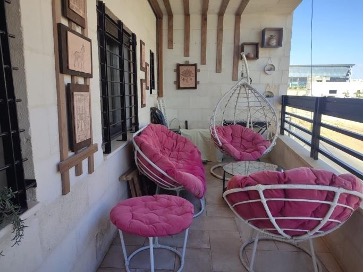
The COVID-19 pandemic has brought about profound and lasting changes in how people engage with their residential built environments, elevating the importance of balconies in urban housing settings. In Amman, Jordan, a city characterized by high residential density, distinct climatic conditions, and rich cultural living traditions, balconies have transformed from peripheral architectural elements into vital semi-outdoor living spaces. These spaces have played a critical role during lockdown periods by supporting residents' physical activity, mental health, and social interaction, thereby mitigating some of the adverse effects of prolonged home confinement. This study employs a comprehensive mixed-methods approach, integrating quantitative data from an online survey of 150 residents alongside in-depth qualitative interviews with 20 participants, to investigate evolving balcony usage patterns. It particularly focuses on how physical characteristics—including balcony size, orientation, and shading—affect the ability of these spaces to adapt to varied user needs. The findings underscore the multifunctionality of balconies as restorative environments that foster inclusivity by accommodating people of different ages and abilities, while also revealing ongoing accessibility challenges that need to be addressed. Ultimately, this research offers evidence-based, climate- and culture-sensitive architectural and urban design recommendations aimed at enhancing residential resilience, promoting social equity, and ensuring the sustainability of urban living spaces in the post-pandemic era.
Ahern, Jack. 2011. "Urban Resilience: A Cultural-Ecological Framework." Landscape and Urban Planning 99 (2): 96–107.
Bettaieb, D., and M. Alsabban. 2020. "Balconies as Multifunctional Urban Spaces: A Global Perspective." Journal of Urban Design and Architecture 15 (3): 203–19.
Braun, Virginia, and Victoria Clarke. 2006. "Using Thematic Analysis in Psychology." Qualitative Research in Psychology 3 (2): 77–101.
Bratman, Gregory N., Charles B. Anderson, Michelle G. Berman, Brian Cochran, Sjerp de Vries, Jeffrey Flanders, et al., and Gretchen C. Daily. 2020. "Nature and Mental Health: An Ecosystem Service Perspective." Science Advances 6 (48): eaba3874. https://doi.org/10.1126/sciadv.aba3874.
Creswell, John W., and Vicki L. Plano Clark. 2018. Designing and Conducting Mixed Methods Research. 3rd ed. Sage Publications.
Department of Architecture Engineering, Jordan University. 2020. Studies on Residential Balconies in Amman. Internal report.
Frost, R., et al. 2021. "Balcony Use and Mental Health during COVID-19 Lockdowns in Global Cities." International Journal of Environmental Research and Public Health 18 (7): 3536.
Grigoriadou, E. T. (2021). The urban balcony as the new public space for well-being in times of social distancing. Cities & Health, 5(sup1), S208–S211.
Hajjar, R., Anders Ellegard, and Ashraf M. Salama. 2021. "From Passive to Performative: Balconies in Contemporary Urban Living." Urban Architecture Review 23 (1): 54–72.
Kaplan, Rachel, and Stephen Kaplan. 1989. The Experience of Nature: A Psychological Perspective. Cambridge University Press.
Jagannathan, I. P. (2024). Thinna as a quasi-public space: The case of leather homeworkers in Southern India. Gender & Development, 32(1–2), 493–510.3.
Kellert, Stephen R., Judith Heerwagen, and Martin Mador. 2008. Biophilic Design: The Theory, Science, and Practice of Bringing Buildings to Life. Wiley.
Khalil, A., and S. Eissa. 2022. "Role and Design of Balconies in Middle Eastern and Mediterranean Residential Architecture." Journal of Middle Eastern Architecture 12 (2): 102–119.
Lefebvre, Henri. 1991. The Production of Space. Translated by Donald Nicholson-Smith. Blackwell Publishing. (Originally published 1974) .
Pitarch, Marta. 2020. "Balconies and Urban Resilience: Social Cohesion during Crisis." Journal of Urban Affairs 42 (6): 883–900.
Radon, Katja, Jonas Hegewald, Verena Ehrenstein, et al. 2020. "Access to Green Space and Mental Health during the COVID-19 Pandemic." Environmental Research 191: 110215.
Ramiz, L., and N. Alkurdi. 2021. "Re-imagining Residential Balconies during Lockdown: Psychological and Social Perspectives." Housing and Society 48 (2): 194–213.
Silva, E., F. Martinez, and M. Garcia. 2022. "Balconies as Community Expressions in European Cities during COVID-19." European Journal of Urban Studies 29 (3): 201–22.
Søholt, Stine. 2020. "Balconies as Social Interfaces in Dense Urban Housing." Housing, Theory and Society 37 (1): 108–26.
Taneja, M. (2024). Women’s search for public space and leisure in Agra: Cots, courtyards, and riverbank. Gender & Development, 32(1–2), 177–199.
Ribeiro, C., Flores-Colen, I., Valentim Lopes, N., & Ramos, N. M. (2024). The balcony as an archetype of well-being: A critical literature review. Archnet-IJAR: International Journal of Architectural Research.
Torres, J., et al. 2021. "Balcony Use, Perception, and Spatial Reconfiguration during the Pandemic." Journal of Urban Health 98 (4): 567–79.
Zarrabi, M., et al. 2020. "Biophilic Elements in High-Density Residential Balconies and Mental Wellbeing." Sustainable Cities and Society 62: 102391.
Copyright (c) 2026 Rama AlMajali

This work is licensed under a Creative Commons Attribution-NonCommercial-ShareAlike 4.0 International License.
Authors who publish with this journal agree to the following terms:
- Authors retain copyright and grant the journal right of first publication with the work simultaneously licensed under a Creative Commons Attribution License that allows others to share the work with an acknowledgement of the work's authorship and initial publication in this journal which is under a Attribution-NonCommercial-ShareAlike 4.0 International license (CC BY-NC-SA 4.0).
- Authors are able to enter into separate, additional contractual arrangements for the non-exclusive distribution of the journal's published version of the work (e.g., post it to an institutional repository or publish it in a book), with an acknowledgement of its initial publication in this journal.
- Authors are permitted and encouraged to post their work online (e.g., in institutional repositories or on their website) prior to and during the submission process, as it can lead to productive exchanges, as well as earlier and greater citation of published work (See The Effect of Open Access).