Urban Microclimate and Outdoor Thermal Comfort in Hot-Arid Cities
Simulation-Based Analysis in Egypt’s New Administrative Capital

Downloads
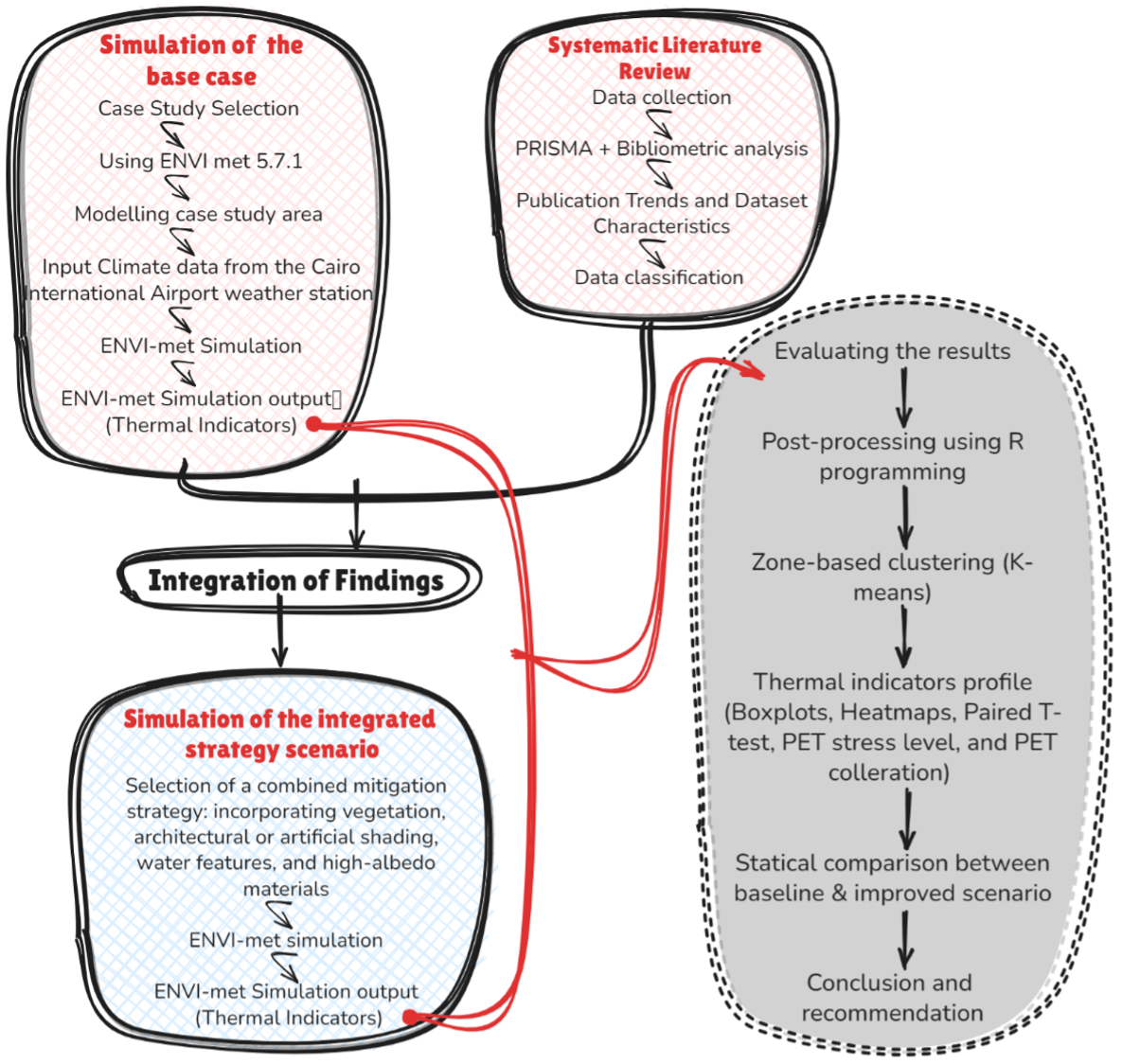
Outdoor thermal comfort is a critical determinant in the quality of urban life in hot-arid climates, particularly within newly developed governmental districts. This study employs a sequential mixed-methods approach to evaluate outdoor thermal comfort in the Governmental District of Egypt’s New Administrative Capital. A systematic literature review following the PRISMA protocol, supported by bibliometric analysis, was conducted to identify effective climate-responsive mitigation strategies. The study area was classified into five thermal zones using K-means clustering to assess microclimatic conditions before and after the implementation of integrated design interventions. Simulation results based on Physiological Equivalent Temperature (PET), selected as the primary outdoor thermal comfort index due to its widespread application in ENVI-met-based hot-arid studies, reveal substantial thermal improvements across all zones, with improvements exceeding 10 °C in specific areas. Thermal stress classification indicates a shift from extreme heat stress to moderate and slight stress levels, indicating the thermal mitigation potential of the applied interventions. The findings provide a zone-based analytical framework with potential applicability to climate-responsive urban design in comparable hot-arid environments.
Akbari, H., C. Cartalis, D. Kolokotsa, A. Muscio, A. L. Pisello, F. Rossi, M. Santamouris, A. Synnefa, N. H. Wong, and M. Zinzi. 2016. “Local Climate Change and Urban Heat Island Mitigation Techniques: The State of the Art.” Journal of Civil Engineering and Management 22 (1): 1–16. https://doi.org/10.3846/13923730.2015.1111934.
Alghannam, A. R. O., and M. R. A. Al-Qahtani. 2012. “Impact of Vegetation Cover on Urban and Rural Areas of Arid Climates.” Australian Journal of Agricultural Engineering 3 (1): 1–5. https://search.informit.org/doi/epdf/10.3316/informit.339109686132992
Arruda, H. 2022. “VOSviewer and Bibliometrix.” Journal of the Medical Library Association 110 (3): 392–395. https://jmla.pitt.edu/ojs/jmla/article/view/1434
Bruse, M., and H. Fleer. 1998. “Simulating Surface–Plant–Air Interactions inside Urban Environments with a Three-Dimensional Numerical Model.” Environmental Modelling & Software 13 (3–4): 373–384. https://doi.org/10.1016/S1364-8152(98)00042-5
Chaudhuri, S., and A. Kumar. 2022. “Urban Greenery for Air Pollution Control: A Meta-Analysis of Current Practice, Progress, and Challenges.” Environmental Monitoring and Assessment 194: 235. https://doi.org/10.1007/s10661-022-09808-w
Coccolo, S., J. Kämpf, J. L. Scartezzini, and D. Pearlmutter. 2016. “Outdoor Human Comfort and Thermal Stress: A Comprehensive Review on Models and Standards.” Urban Climate 18: 33–57. https://doi.org/10.1016/j.uclim.2016.08.004
Fahmy, M., S. Mahmoud, I. Elwy, and H. Mahmoud. 2020. “A Review and Insights for Eleven Years of Urban Microclimate Research towards a New Egyptian Era of Low-Carbon, Comfortable, and Energy-Efficient Housing Typologies.” Atmosphere 11 (3): 236. https://doi.org/10.3390/atmos11030236
Fu, J., K. Dupre, S. Tavares, D. King, and Z. Banhalmi-Zakar. 2022. “Optimized Greenery Configuration to Mitigate Urban Heat: A Decade Systematic Review.” Frontiers of Architectural Research 11: 466–491. https://doi.org/10.1016/j.foar.2021.12.005
Givoni, B. 1998. Climate Considerations in Building and Urban Design. John Wiley & Sons.
Hakim, B. S., A. Ahmad, and N. Bayazit. 1998. Reviving the Islamic City: Historic Preservation in the Muslim World. Center for Muslim Contribution to Civilization.
Halder, N., M. Kumar, A. Deepak, S. K. Mandal, A. Azmeer, B. A. Mir, A. Nurdiawati, and S. G. Al-Ghamdi. 2025. “The Role of Urban Greenery in Enhancing Thermal Comfort: Systematic Review Insights.” Sustainability 17 (6): 2545. https://doi.org/10.3390/su17062545
Hartigan, J. A., and M. A. Wong. 1979. “Algorithm AS 136: A K-means Clustering Algorithm.” Journal of the Royal Statistical Society, Series C (Applied Statistics) 28 (1): 100–108. https://doi.org/10.2307/2346830
Hass-Klau, C. 1993. “Impact of Pedestrianization and Traffic Calming on Retailing: A Review of the Evidence from Germany and the UK.” Transport Policy 1 (1): 21–31.
Höppe, P. 1999. “The Physiological Equivalent Temperature: A Universal Index for the Biometeorological Assessment of the Thermal Environment.” International Journal of Biometeorology 43 (2): 71–75. https://doi.org/10.1007/s004840050118
Jacobs, J. 1972. The Death and Life of Great American Cities. New York: Penguin Books.
James, G., D. Witten, T. Hastie, and R. Tibshirani. 2013. An Introduction to Statistical Learning: With Applications in R. Vol. 103. New York: Springer.
Johansson, E., S. Thorsson, R. Emmanuel, and E. Krüger. 2014. “Instruments and Methods in Outdoor Thermal Comfort Studies–The Need for Standardization.” Urban Climate 10: 346–366. https://doi.org/10.1016/j.uclim.2013.12.002
Kirby, A. 2023. “Exploratory Bibliometrics: Using VOSviewer as a Preliminary Research Tool.” Publications 11 (1): 10. https://www.mdpi.com/2304-6775/11/1/10
Li, J., Y. Mao, J. Ouyang, and S. Zheng. 2022. “A Review of Urban Microclimate Research Based on CiteSpace and VOSviewer Analysis.” International Journal of Environmental Research and Public Health 19 (8): 4741. https://www.mdpi.com/1660-4601/19/8/4741
Lin, T.-P., A. Matzarakis, and R.-L. Hwang. 2010a. “Shading Effect on Long-Term Outdoor Thermal Comfort.” Building and Environment 45 (1): 213–221. https://doi.org/10.1016/j.buildenv.2009.06.002
Lin, T.-P., R. de Dear, and R.-L. Hwang. 2010b. “Effect of Thermal Adaptation on Seasonal Outdoor Thermal Comfort.” International Journal of Climatology 31 (2): 302–312. https://doi.org/10.1002/joc.2120
Makaremi, N., E. Salleh, M. Z. Jaafar, and A. Ghaffarianhoseini. 2012. “Thermal Comfort Conditions of Shaded Outdoor Spaces in a Hot and Humid Climate of Malaysia.” Building and Environment 48: 7–14. https://doi.org/10.1016/j.buildenv.2011.07.024
Matzarakis, A., and H. Mayer. 1996. “Another Kind of Environmental Stress: Thermal Stress.” WHO Newsletter 18: 7–10.
Matzarakis, A., H. Mayer, and M. G. Iziomon. 1999. “Applications of a Universal Thermal Index: Physiological Equivalent Temperature.” International Journal of Biometeorology 43 (2): 76–84. https://doi.org/10.1007/s004840050119
Mayer, H., and P. Höppe. 1987. “Thermal Comfort of Man in Different Urban Environments.” Theoretical and Applied Climatology 38 (1): 43–49.
Middel, A., J. Lukasczyk, R. Maciejewski, M. Demuzere, and M. Roth. 2018. “Sky View Factor Footprints for Urban Climate Modeling.” Urban Climate 25: 120–134. https://doi.org/10.1016/j.uclim.2018.05.004
Ministry of Planning and Economic Development. 2021. Egypt Vision 2030: Sustainable Development Strategy. Cairo: Government of Egypt. https://mped.gov.eg/Files/Egypt_Vision_2030_EnglishDigitalUse.pdf
Moher, D., A. Liberati, J. Tetzlaff, D. G. Altman, and The PRISMA Group. 2009. “Preferred Reporting Items for Systematic Reviews and Meta-Analyses: The PRISMA Statement.” PLoS Medicine 6 (7): e1000097. https://doi.org/10.1371/journal.pmed.1000097
Nasrollahi, N., A. Ghosouri, J. Khodakarami, and M. Taleghani. 2020. “Heat-Mitigation Strategies to Improve Pedestrian Thermal Comfort in Urban Environments: A Review.” Sustainability 12 (23): 10000. https://doi.org/10.3390/su122310000
Oke, T. R. 1987. Boundary Layer Climates. 2nd ed. London: Routledge.
Page, M. J., J. E. McKenzie, P. M. Bossuyt, I. Boutron, T. C. Hoffmann, C. D. Mulrow, L. Shamseer, J. M. Tetzlaff, E. A. Akl, S. E. Brennan, et al. 2021. “The PRISMA 2020 Statement: An Updated Guideline for Reporting Systematic Reviews.” BMJ 372: n71. https://www.bmj.com/content/372/bmj.n71
Potchter, O., P. Cohen, T.-P. Lin, and A. Matzarakis. 2018. “Outdoor Human Thermal Perception in Various Climates: A Comprehensive Review of Approaches, Methods and Quantification.” Science of the Total Environment 631: 390–406. https://doi.org/10.1016/j.scitotenv.2018.02.276
R Core Team. 2024. “R: A Language and Environment for Statistical Computing.” Vienna, Austria: R Foundation for Statistical Computing.
Salata, F., I. Golasi, D. Petitti, and A. de Lieto Vollaro. 2017. “Relating Microclimate, Human Thermal Comfort, and Health during Heat Waves: An Analysis of Heat Island Mitigation Strategies through a Case Study in an Urban Outdoor Environment.” Sustainable Cities and Society 30: 79–96. https://doi.org/10.1016/j.scs.2017.01.006
Santamouris, M. 2020. Minimizing the Urban Heat Island and Thermal Stress through the Development of Cool Cities. Amsterdam: Elsevier.
Shashua-Bar, L., D. Pearlmutter, and E. Erell. 2011. “The Influence of Trees and Grass on Outdoor Thermal Comfort in a Hot-Arid Environment.” International Journal of Climatology 31 (10): 1498–1506. https://doi.org/10.1002/joc.2177
Taleghani, M. 2018. “The Impact of Increasing Urban Surface Albedo on Outdoor Summer Thermal Comfort within a University Campus.” Urban Climate 24: 229–243. https://doi.org/10.1016/j.uclim.2018.03.001
Taleghani, M., L. Kleerekoper, M. Tenpierik, and A. van den Dobbelsteen. 2016. “Outdoor Thermal Comfort within Five Different Urban Forms in the Netherlands.” Building and Environment 83: 65–78. https://doi.org/10.1016/j.buildenv.2014.03.014
UN-Habitat. 2015. Global Public Space Toolkit: From Global Principles to Local Policies and Practice. Nairobi: United Nations Human Settlements Programme.
Van Eck, N., and L. Waltman. 2010. “Software Survey: VOSviewer, a Computer Program for Bibliometric Mapping.” Scientometrics 84 (2): 523–538. https://doi.org/10.1007/s11192-009-0146-3
Whyte, W. H. 1988. City: Rediscovering the Center. New York: Doubleday.
Zölch, T., M. A. Rahman, E. Pfleiderer, G. Wagner, and S. Pauleit. 2019. “Designing Public Squares with Green Infrastructure to Optimize Human Thermal Comfort.” Building and Environment 149: 640–654. https://doi.org/10.1016/j.buildenv.2018.12.051
Copyright (c) 2026 Norhan Mahmoud Mohamed Ibrahim Ali, Ahmed Aboulsaadat, Ingy El-Darwish, Ayman Abdeltawab

This work is licensed under a Creative Commons Attribution-NonCommercial-ShareAlike 4.0 International License.
Authors who publish with this journal agree to the following terms:
- Authors retain copyright and grant the journal right of first publication with the work simultaneously licensed under a Creative Commons Attribution License that allows others to share the work with an acknowledgement of the work's authorship and initial publication in this journal which is under a Attribution-NonCommercial-ShareAlike 4.0 International license (CC BY-NC-SA 4.0).
- Authors are able to enter into separate, additional contractual arrangements for the non-exclusive distribution of the journal's published version of the work (e.g., post it to an institutional repository or publish it in a book), with an acknowledgement of its initial publication in this journal.
- Authors are permitted and encouraged to post their work online (e.g., in institutional repositories or on their website) prior to and during the submission process, as it can lead to productive exchanges, as well as earlier and greater citation of published work (See The Effect of Open Access).